
Every time we open our phone, businesses and content creators are competing for our attention on every digital platform. As business owners we know we need to post regularly, and posting regularly can create more opportunities for visibility, but that’s not the same as generating meaningful engagement. We need to create content about our products and services that will meet audience preferences but will also drive our customers through the marketing funnel. I have found research that supports this audience centred approach from Clemens Koob, which stated that content marketing is more effective when the content aligns with not only your needs but also that of your target customer needs as well and when you regularly measure it and use that data to update future content Koob, (2021).
This blog post is about my mission to find out if businesses are prioritising posting frequency over producing content that their audiences are actually finding relevant, useful, and engaging. In a bid to find out, I created a survey early last week and made it publicly available for responses. I hope you find my findings of interest!
Methodology
This survey was conducted in early November by using an online questionnaire using Microsoft Forms, which was shared on my LinkedIn personal and company page, my personal Facebook profile, a WhatsApp group with Irish based marketers and small business owners and also in the Digital Marketing MSc WhatsApp group I am in, which generated 32 responses. I used multiple choice and open ended questions, and respondents represented an age range of 18-65+ year olds; however, it is worth noting that 19 of those respondents were aged between 45-64. The relatively small sample size and the way the participants were recruited mean that the findings cannot be considered representative of all social media users. The findings are also their reported preferences and behaviours, rather than observed ones (Saunders, Lewis and Thornhill, 2019).
Popular Platforms
After asking the age range of my respondents, I asked about the social media platforms they would typically use each week. The popularity of Facebook (26/32) and Instagram (25/32) were the top two platforms, with LinkedIn right behind (19/32), YouTube (18/32), TikTok (14/32), Snapchat (11/32), X (7/32), Pinterest (4/32), and Other (1/32).
Visibility versus Relevance
One noticeable observation from the survey was the difference between how frequently respondents saw business content and how relevant they considered that content to them.
Twenty-seven of thirty-two participants (84.4%) stated they saw a business’ content several times per day; however, only eight respondents (25%) considered the content to often or always be relevant to their interests or needs. Eighteen respondents (56.3%) said it was only relevant sometimes, while six (18.8%) said it was rarely relevant.
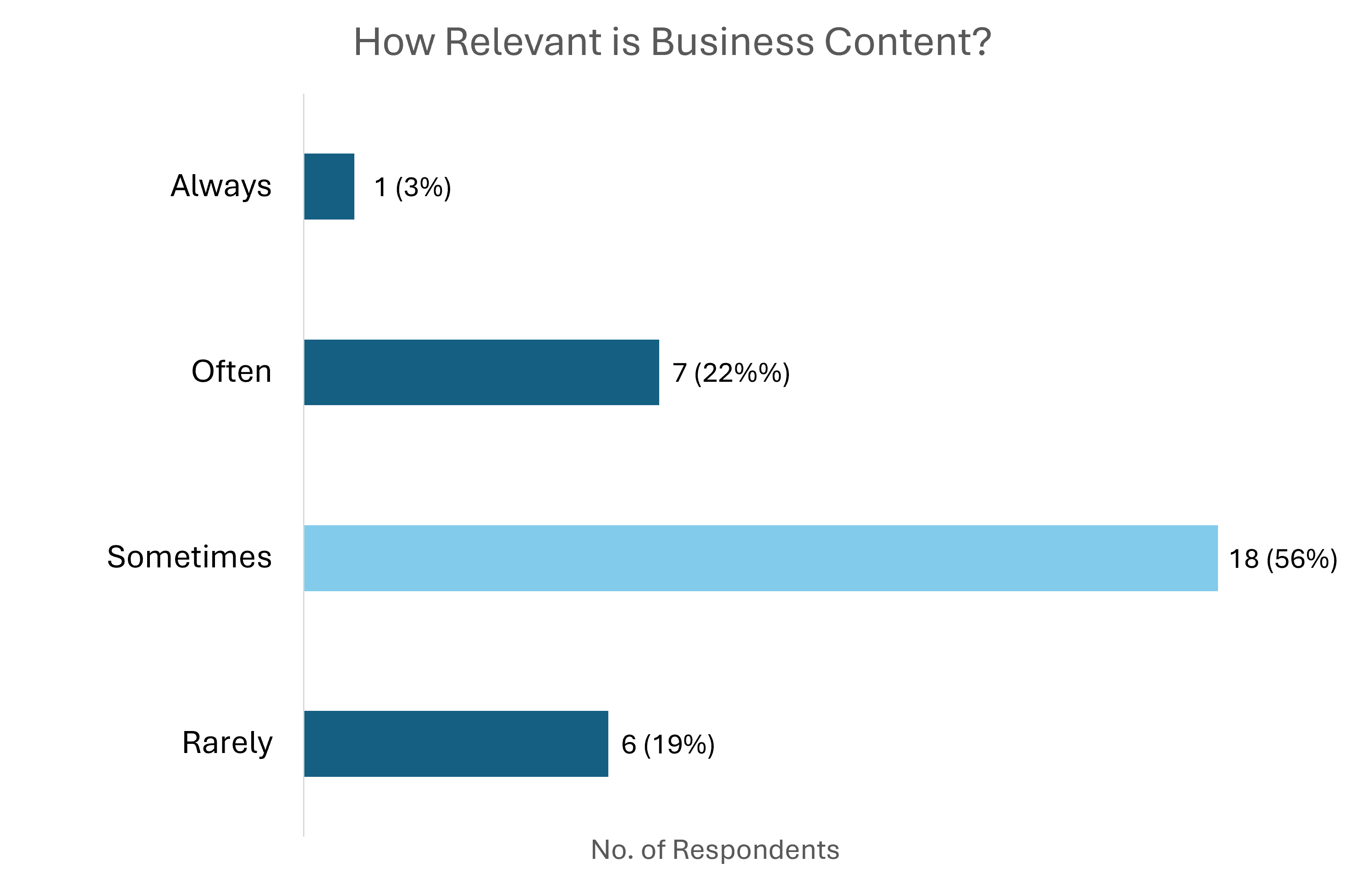
While my survey doesn't prove that posting more frequently makes content less relevant, it does raise a question: whether businesses are spending enough time understanding what their audience actually wants to see, rather than just concentrating on posting regularly.
What Do Audiences Actually Want?
My survey found that the types of content most consumed by my respondents were helpful tips and advice, as selected by twenty-one participants (65.6%). Then educational or informative content and entertaining and humorous posts were each selected by fourteen respondents (43.8%). I was surprised to see videos and demonstrations and special offers and discounts were only selected by eleven respondents (34.4%), however.
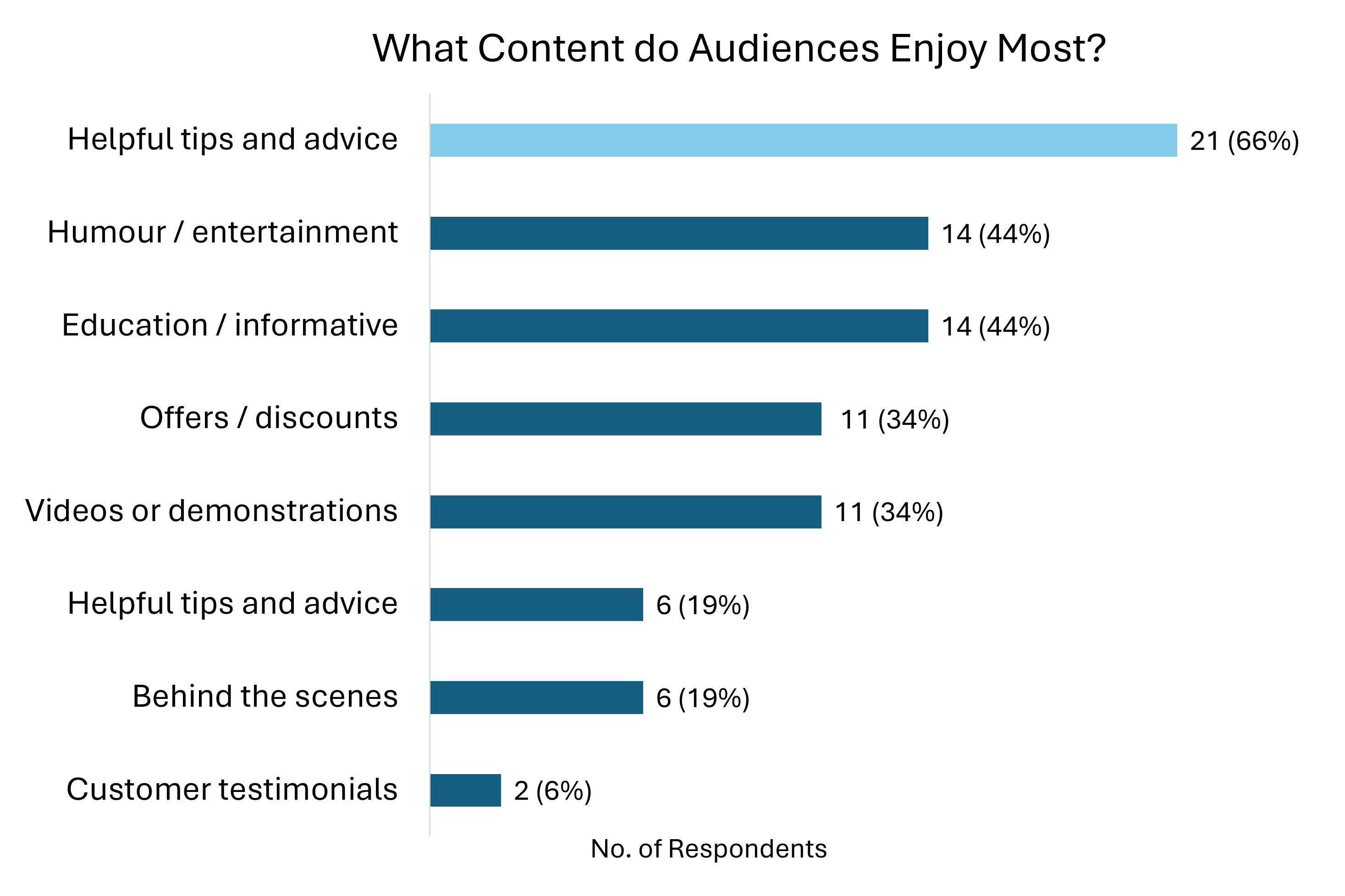
From this survey, it suggests that these respondents valued content that offers something beyond direct sales. They prefer practical information, entertainment, and education, and this may encourage more engagement from the audience (Koob, 2021).
It was noted from the responses that more than a third of the respondents showed they enjoyed special offers and discounts. From this information, it demonstrates that a balance of helpful content and sales content is accepted and expected by our audiences.
What Makes Audiences Stop Following Business?
By getting an understanding of what our audience dislikes, it helps us identify what they prefer to consume. To this end, I asked in my survey what a business would need to do to make them hide or unfollow a business. Unsurprisingly, too many promotional posts were a top offender (56.3%), while inauthentic content (31.3%) and then excessive posting (25%) followed next.
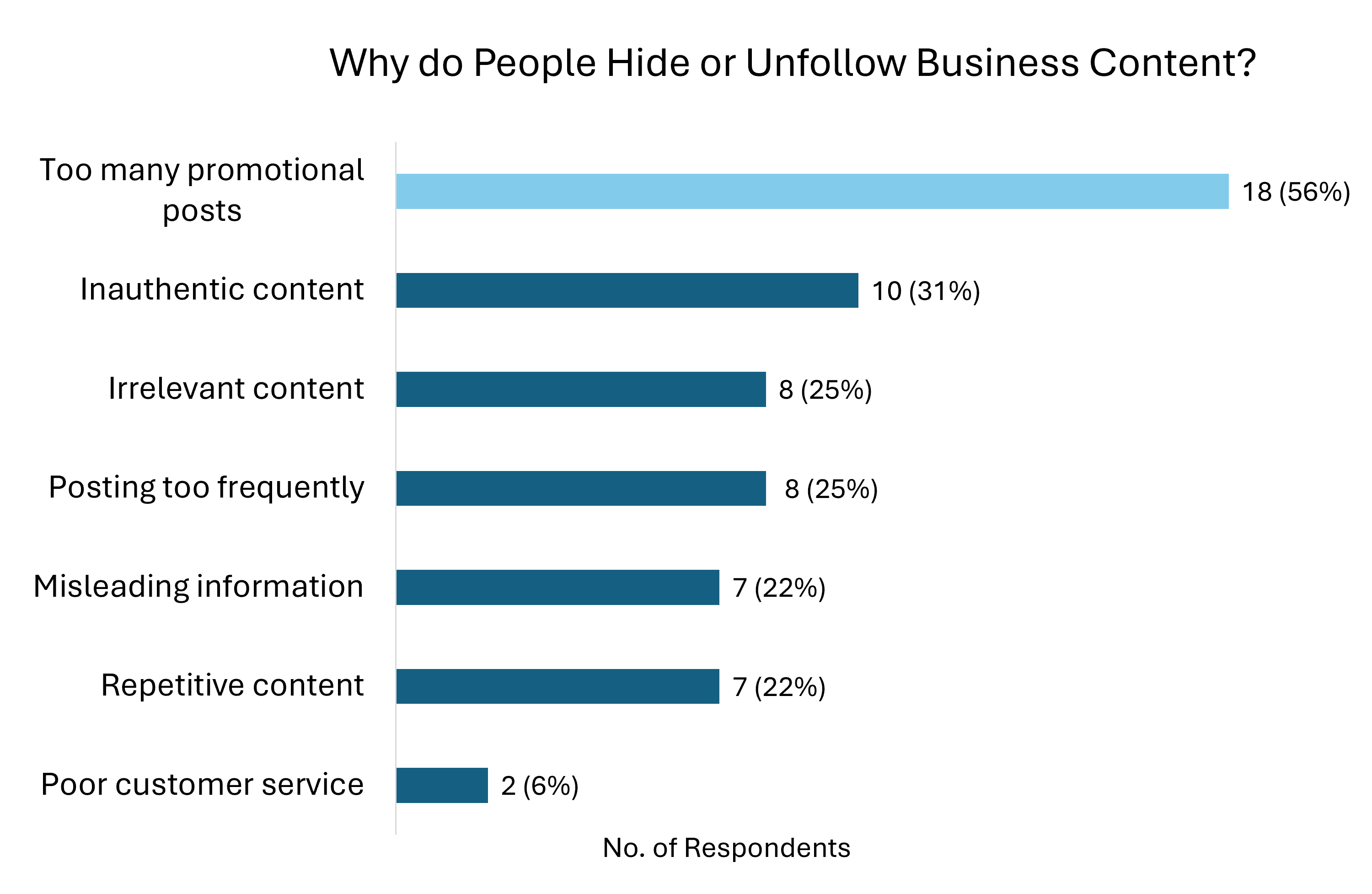
This highlights that our audience is not seeing what they want to see and the content is not matching their expectations to a large degree (Koob, 2021).
One respondent stated: “Slow down on selling and offer advice; the sales will follow if you trust the brand.”
One other respondent preferred businesses to be more authentic and less polished with their video content. The perfectionists among us will find that hard to do.
The importance of trust and credibility are vital, as displayed by the respondent’s feedback. Lou and Yuan looked at how the message value and credibility influenced consumer trust with branded content in influencer marketing. Their research specifically focuses on influencers; however, it does provide a useful perspective on the relationship between content credibility and audience trust (Lou and Yuan, 2019).
What Can a Business Learn from This Survey?
This survey highlights the importance of the business building a better understanding of their customer needs and expectations. Thirty-one out of thirty-two respondents (96.9%) agreed or strongly agreed that a business should spend more time on what their customers want to see on social media.
This suggests that rather than getting direct feedback from their customers and building a suitable content strategy, businesses are trying to be too "salesy" and promotional. They may be relying more on trends rather than strategy (Koob, 2021).
With twenty-three respondents (71.9%) stating that they purchased products or services after consuming organic social media content. This suggests that unpaid content may contribute to some sales, as long as it meets the expectations of the customers.
Ideally, marketers need to know that generating posts without purpose is not sufficient. We need to understand what engagement represents, and this in turn will improve trust in our brand and encourage people to purchase from us.
What Does This Mean for Businesses?
Although the survey was small, with only thirty-two respondents, it does unsurprisingly suggest that audiences would rather have businesses provide relevant, useful, and authentic content rather than being sold to all the time. It is important to note that as this survey was small and top heavy with an older audience, it won’t be representative of all users.
After working with small businesses over the last 13 years, I realise we all spend a lot of time working in our businesses and not enough on them. This means we tend to create content more for us, rather than considering our customers, which appears to be reflected in this survey.
I deliver a regular Start Your Own Business course through a partner I work with. One of the most important and relevant slides I share is the marketing cycle, as below:
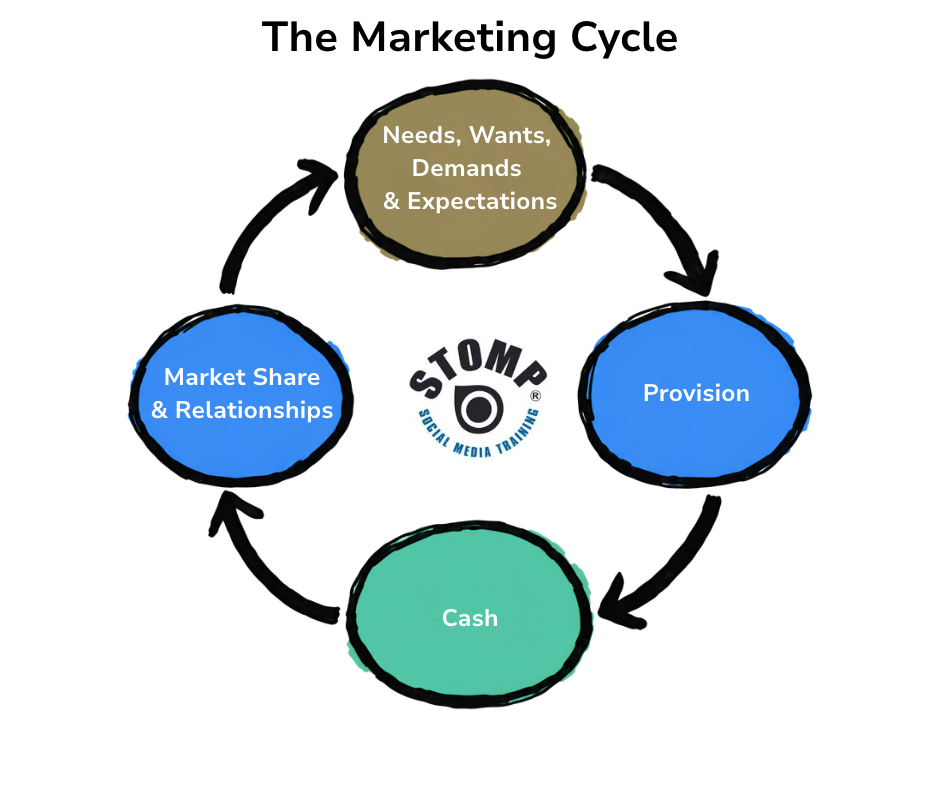
It is important we go back regularly to our customers and deliver the products and services they need, want, demand, and expect to remain competitive in the marketplace. We need to remember that they are a whole person and not just our customer and do our best to maintain the ethos of social media. It’s meant to be social first!
For businesses, the question may not simply be how often they should post, but whether the content they publish gives audiences a reason to pay attention.
References
Koob, C. (2021) ‘Determinants of content marketing effectiveness: Conceptual framework and empirical findings from a managerial perspective,' PLOS ONE, 16(4), e0249457. Available at: https://doi.org/10.1371/journal.pone.0249457 (Accessed: 12 November 2026).
Lou, C. and Yuan, S. (2019) ‘Influencer marketing: How message value and credibility affect consumer trust of branded content on social media,' Journal of Interactive Advertising, 19(1), pp. 58–73. Available at: https://doi.org/10.1080/15252019.2018.1533501 (Accessed: 12 November 2026).
Saunders, M., Lewis, P. and Thornhill, A. (2019). Research methods for business students. 8th edn. Harlow: Pearson Education. Available at: https://www.pearson.com/en-gb/subject-catalog/p/research-methods-for-business-students/P200000005358/9781292208787 (Accessed: 12 November 2026).

Working with clients Nationwide from base in Mullingar.


