Sole traders and SME’s in Ireland are more time poor than ever these days (Biswas and Jha, 2026), and using AI to manage our time only makes sense. Our everyday lives at home are already built around convenience, so it follows we do this in our work lives too. World Bank Senior Vice President and Chief Economist Indermit Gill has said, "AI has thrown developing economies a lifeline, and they should seize it” (World Bank, 2026). It is also a sentiment I share myself.
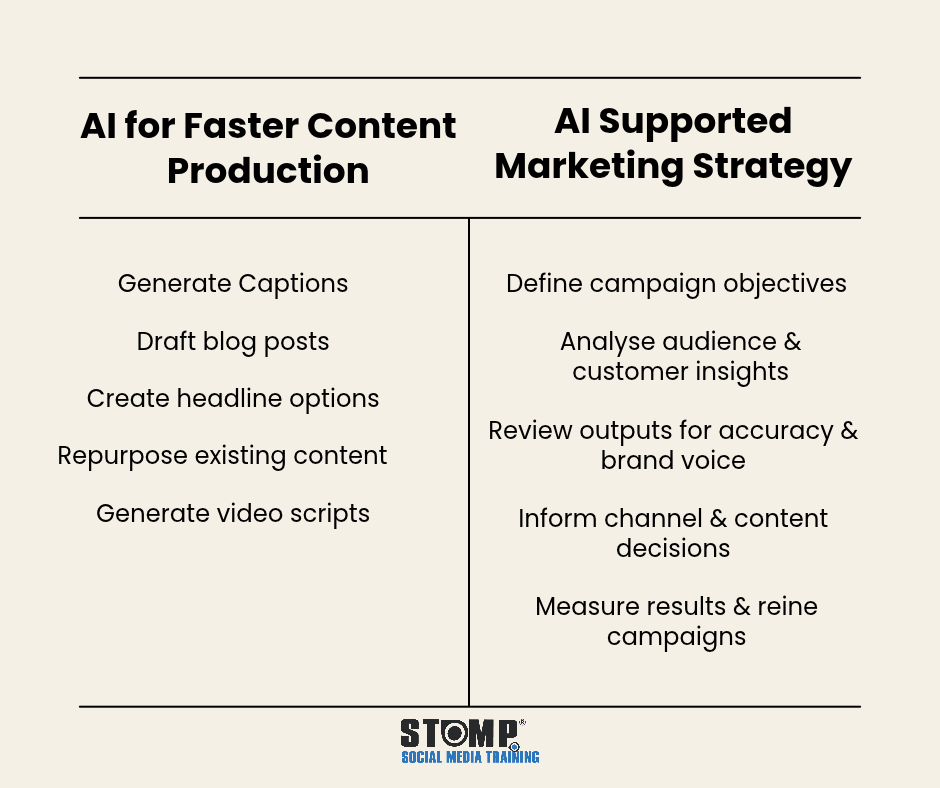
In this blog I look to explore; does using ChatGPT or another AI tool mean a small business has now got an AI supported marketing strategy, or is it simply producing the content more quickly?
In truth, AI can make production of content much faster, but speed alone does not demonstrate a more effective marketing strategy. Its strategic value depends on how businesses use of AI considers their audience insights, campaign objectives and performance measurement. Increasingly I feel we are being challenged ethically about our use of AI. Are we being too hasty in using AI? Is it taking away all of the thought processes and creativity we built and fostered during our childhood?
There is an important distinction between faster production and using AI for better strategy. Huang and Rust (Huang and Rust, 2021) write about how to use mechanical (data collection), thinking (market analysis) and feeling (analysing human interaction) AI for market research and strategy. Where they both pose working with it rather than letting it do the work by itself. My personal view is that AI can be used as a valuable asset when it’s matched with a business’s objectives and their customer expectations and naturally checked by a human for tone of voice and accuracy.
You may have heard the term “cognitive offloading” in the past. This term means handing over physical actions (like social media scheduling) to external tools (like native or third party tools) to reduce overwhelm in mental processing. The same can be said for kettles and washing machines. They both save us time and work with very minimal input from us. This term gained wider recognition as a working concept in 2016 after an article written by Evan F. Risko and Sam Gilbert (Risko and Gilbert, 2016) was published. In this article they even referred to adding a reminder on your phone or calendar to complete a task as cognitive offloading. It is not fully in the domain of AI chatbots that they place this phenomenon.
After reading these articles, maybe AI can be a bit of both? AI can, of course, free a business owner from everyday, routine work and it is capable of higher level decision making, once programmed.
Strategic use can be seen one of two ways. Some businesses could be using it for writing captions and generating content ideas. Others may be using AI to create, implement and oversee a full marketing process. After reading Chaffey, D. & Ellis-Chadwick, F. (2025) Digital Marketing, 9e, Pearson recently, in chapter 1 they outline the importance of having your objective, audiences, customer journey and measurements. There was no mention of AI tools at any stage.
Many of my clients would use AI for the purpose of researching audience questions. It would be a natural go-to to help build and generate content that would answer their customers' needs. Platforms like answerthepublic.com also typically use AI to aggregate data and provide results to meet their customers' needs. AI is ideal for this kind of work.
Another way to use AI is that it can suggest creative ways to repurpose the content you already have into alternative formats. It could suggest better copy / text that is suited to another platform and image design for various social platforms and even scripts for videos.
I have used AI to help me create title headings for blogs and podcast episodes in the past. This helps me optimise them for SEO and for intrigue. It is useful to have that input, and it helps you think more clearly about other better options that you ordinarily wouldn’t consider.
You might find it useful for first drafts as well. AI can offer you a jumping off point or a framework to start from, especially if you are suffering from “writers block”. Would you consider using it for these reasons and then ensuring you edit them to suit your needs and tone of voice? Would this be seen as AI generated content? The line is thinly drawn.
Long before we had access to the world wide web, we would use books, encyclopaedias, and scientific research papers. As the only “trusted” formats would be peer reviewed content, did that mean we didn’t trust books andencyclopaedia previously?
For all of its advances and usefulness, using AI alone is not a strategy. It does unfortunately hallucinate and make errors. The more complicated the task, the greater the error rate. The responses it gives can be quite generic or even repetitive.
It can source articles that are out of date and no longer relevant, so it is well worth reading these articles before adding them as a source. If you have AI writing everything for you, naturally it won’t have your tone of voice, which can be off putting for your audience as well.
Regarding the sourcing, that is also another problem. There have been cases where intellectual property of content has also come under scrutiny. Think of the many images we see online that have been “borrowed” without referencing the photographer or business. This still happens a lot and can be very expensive for businesses to recompense the owner. Agencies like the Associated Press have a team of people scouring the internet, ensuring that their content is not being shared by those that have not paid.
Finally, let us not forget that confidentiality and data protection are concerns that are highlighted frequently in the press. Employees may inadvertently disclose personal or business information like commercial or personal data, intellectual property, or even client records. This kind of data regularly gets inputted into publicly available AI tools. We have all heard how this data can go to teach the platform later for model improvements.
There are several well documented examples of this happening. In 2023, Samsung employees reportedly entered confidential source code and even meeting notes into ChatGPT looking for help with everyday tasks. This incident prompted Samsung to restrict employee use of AI tools and highlighted a gap in the control they had of their proprietary information. (Gurman, 2023)
There was another incident involving OpenAI, which showed even the platforms themselves can experience data concerns. There was a software fault that temporarily enabled some users to view other users’ chattitles. It was also found that there was also a small proportion of ChatGPT Plus subscribers given access to payment related information. (OpenAI, 2023)
These and other similar cases show that organisations cannot assume that AI tools provide a secure or even confidential environment for business information. Businesses and organisations need to create and implement clear acceptable use policies that restrict the use of public AI tools for sensitive information. There is a strong need to provide staff training and if possible, use enterprise or special privacy focused versions to ensure compliance with data protection laws like GDPR.
Using ChatGPT or another AI tool does not automatically give a small business an AI supported marketing strategy. It simply gives the business access to a tool. AI can and will speed up content production, advise on audience research and help repurpose anything you have previously created. All of these are possible, but it does depend on how you use it. When you use AI with a clear objective and make sure it is checked by a human, it becomes a tool that is useful to measure any of your campaign outcomes. It is meant to support the strategy that you have created.
If you are simply using it to generate content, then you run the risk of it coming out with everyday generic responses, factual errors and copyright and data protection concerns. For sole traders and SME’s, AI should not be replacing our own marketing thinking but we might consider allowing AI to support and develop better marketing decisions.
References
Biswas, B., & Jha, A.K. (2026). AI Economy in Ireland, AI Adoption Index Benchmarking and Index. Trinity Business School, Trinity College Dublin in association with Microsoft Ireland. Available from TCD--AI-Economy-Report-2026-Web.pdf
World Bank (2026) AI offers lifeline to developing economies in an era of weak growth [Press release], 4 August. Available at: https://www.worldbank.org/en/news/press-release/2026/08/04/ai-offers-lifeline-to-developing-economies-in-an-era-of-weak-growth (Accessed: 12 October 2026)
Risko, E.F., & Gilbert, S. (2016). Cognitive Offloading. Trends in Cognitive Sciences. Vol. 20 Issue 9. Available from https://samgilbert.net/pubs/Risko2016TiCS.pdf
Huang, M.H. and Rust, R.T. (2021) A Strategic Framework for Artificial Intelligence in Marketing. Journal of the Academy of Marketing Science, 49(1), pp. 30-50. https://econpapers.repec.org/article/sprjoamsc/v_3a49_3ay_3a2021_3ai_3a1_3ad_3a10.1007_5fs11747-020-00749-9.htm
Chaffey, D., & Ellis-Chadwick, F. (2025) Digital Marketing, 9e, Pearson. Available from https://www.pearson.com/en-gb/subject-catalog/p/digital-marketing/P200000012456?
Gurman, M. (2023) Samsung Bans Staff’s AI Use After Spotting ChatGPT Data Leak. Bloomberg. May 2nd 2023. Accessed 16th October 2026. https://www.bloomberg.com/news/articles/2023-05-02/samsung-bans-chatgpt-and-other-generative-ai-use-by-staff-after-leak
OpenAI, (2023) March 20 ChatGPT outage: Here’s what happened. An update on our findings, the actions we’ve taken, and technical details of the bug. Website update. March 24th 2023. Accessed 16th October 2026. https://openai.com/index/march-20-chatgpt-outage/

Working with clients Nationwide from base in Mullingar.


